
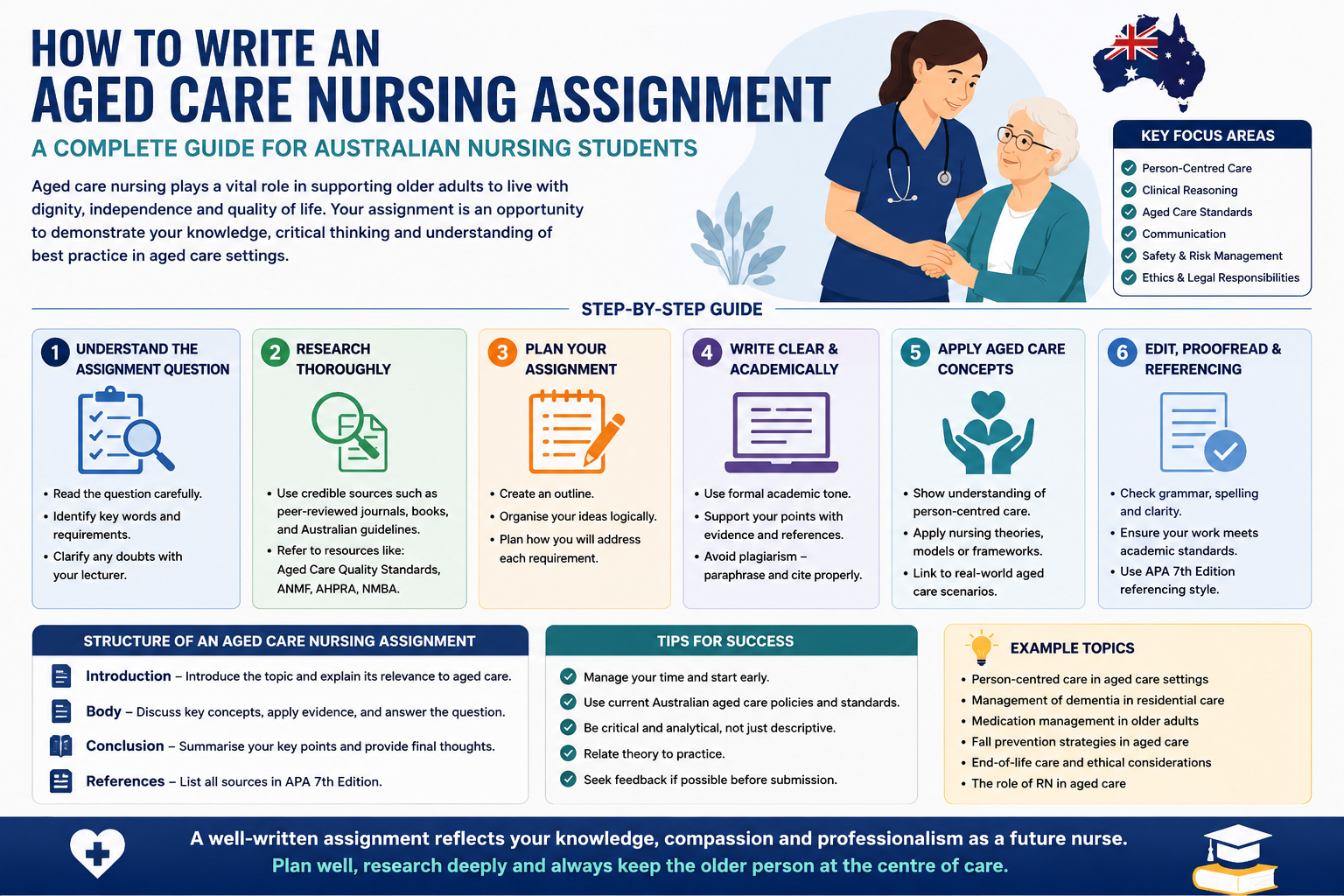
How to Write an Aged Care Nursing Assignment: A Complete Guide for Australian Nursing Students
Writing an aged care nursing assignment can be challenging because it requires more than simply describing the health needs of an older person. A strong assignment combines nursing knowledge, clinical reasoning, evidence-based practice, person-centred care, ethical considerations and appropriate academic referencing.
Whether you are writing an aged care case study, nursing care plan, reflective assignment, research paper or essay, having a clear structure can make the writing process much easier.
This guide explains how to write an aged care nursing assignment step by step and provides practical tips for Australian nursing students.
What Is an Aged Care Nursing Assignment?
An aged care nursing assignment is an academic task that examines the health, wellbeing, care needs and nursing management of older adults.
Depending on your course, you may be asked to analyse a patient case, develop a nursing care plan, discuss an aged care issue, evaluate research evidence or reflect on a clinical experience.
Common aged care nursing assignments include:
Aged care nursing essays
Aged care case studies
Nursing care plans
Dementia nursing assignments
Gerontological nursing assignments
Reflective nursing assignments
Palliative care assignments
Clinical assessment assignments
Literature reviews
Evidence-based practice assignments
Aged care research papers
Health promotion assignments
The assignment question and marking rubric should always determine what you include in your paper.
Step 1: Understand the Assignment Question
Before starting your research, carefully read the assignment question.
Look for the instruction words used in the question. These words tell you what your lecturer expects.
For example:
Describe – explain the main features of a topic.
Explain – provide reasons and details.
Discuss – explore different aspects of an issue.
Analyse – examine information in detail and identify relationships.
Evaluate – make a judgement using evidence.
Critically analyse – examine evidence, strengths, limitations and implications.
Reflect – connect an experience with learning and professional development.
For example, if your question asks you to critically analyse falls prevention strategies in older adults, simply listing falls prevention methods is not enough.
You should discuss the evidence, compare approaches, consider their benefits and limitations, and explain their relevance to nursing practice.
Step 2: Read the Marking Rubric
The marking rubric is one of the most important resources for your assignment.
Before researching, identify:
Required learning outcomes
Number of sections required
Word count
Required sources
Referencing style
Critical analysis expectations
Clinical requirements
Formatting requirements
Submission instructions
You can use the rubric as a checklist while writing.
For example, if critical analysis accounts for a significant percentage of your marks, your assignment should contain more than descriptions and definitions. You should demonstrate comparison, interpretation and evaluation of evidence.
Step 3: Research the Aged Care Topic
Once you understand the question, start researching your topic.
Use reliable academic and professional sources such as:
Peer-reviewed journal articles
Australian government resources
Aged Care Quality and Safety Commission resources
Australian health organisations
University library databases
Clinical guidelines
Systematic reviews
Evidence-based nursing resources
Avoid relying heavily on random websites, blogs or sources without clear authorship.
When researching Australian aged care topics, make sure you check whether the information reflects the current regulatory framework.
The strengthened Australian Aged Care Quality Standards took effect on 1 November 2025. They replaced the previous eight standards with seven strengthened standards.
Step 4: Understand the Current Australian Aged Care Quality Standards
If your assignment relates to aged care in Australia, understanding the current standards can be important.
There are seven strengthened Aged Care Quality Standards:
Standard 1 – The individual
Standard 2 – The organisation
Standard 3 – The care and services
Standard 4 – The environment
Standard 5 – Clinical care
Standard 6 – Food and nutrition
Standard 7 – The residential community
The Aged Care Quality and Safety Commission explains that these standards define expectations around safe and quality aged care.
For example, Standard 1 focuses on treating older people with dignity and respect, supporting choice and independence, and putting their safety, health, wellbeing and quality of life first.
Standard 3 focuses on care and services being tailored to the needs, goals and preferences of older people, including appropriate planning and coordination.
Standard 5 specifically addresses clinical care and includes person-centred, safe, quality, evidence-based and coordinated clinical care.
Therefore, when writing an Australian aged care nursing assignment, always check which current standards are relevant to your topic.
Step 5: Create an Assignment Outline
Do not start writing immediately after collecting your research.
Create an outline first.
A typical aged care nursing assignment can follow this structure:
Introduction
Introduce the topic
Provide brief background
Explain the purpose of the assignment
Identify the main areas that will be discussed
Main Body
Discuss the patient's or population's needs
Explain relevant nursing concepts
Analyse clinical issues
Discuss nursing interventions
Apply evidence
Consider person-centred care
Discuss ethical and professional considerations
Connect the discussion to relevant Australian standards where appropriate
Conclusion
Summarise the main findings
Reinforce important nursing implications
Avoid introducing completely new information
A clear outline prevents repetition and helps keep the assignment focused.
Step 6: Write a Strong Introduction
Your introduction should give the reader a clear understanding of the assignment.
A good introduction generally includes:
Background
Introduce the aged care issue or clinical topic.
Context
Explain why the topic is relevant to older-person health or nursing practice.
Purpose
State what the assignment will examine.
Structure
Briefly indicate the key areas that will be discussed.
For example, an assignment about dementia care might introduce dementia as a significant consideration in older-person nursing, identify the focus of the case, and explain that the discussion will examine assessment, person-centred care, communication and nursing interventions.
Avoid putting excessive detail into the introduction. Save your evidence and detailed analysis for the main body.
Step 7: Develop the Main Body
The main body is where you demonstrate your nursing knowledge and critical thinking.
Each paragraph should have a clear purpose.
A useful paragraph structure is:
Point → Evidence → Explanation → Application → Link
Point
Introduce the main idea.
Evidence
Support the idea with an appropriate academic source.
Explanation
Explain what the evidence means.
Application
Connect the evidence to the patient, case study or aged care situation.
Link
Connect the paragraph back to the assignment question.
This approach can help prevent paragraphs from becoming simple lists of information.
Step 8: Focus on Person-Centred Care
Person-centred care is particularly important in aged care nursing.
Your assignment should consider the older person's:
Preferences
Goals
Values
Independence
Dignity
Privacy
Communication needs
Cultural considerations
Physical needs
Psychological wellbeing
Social relationships
Quality of life
Australian Standard 1 specifically emphasises person-centred care, dignity, respect, choice, independence and quality of life.
Instead of discussing only the disease or clinical problem, consider the individual behind the diagnosis.
For example, a falls prevention care plan should not focus exclusively on restricting mobility. It should also consider the person's independence, preferences, mobility goals and quality of life.
Step 9: Use Evidence-Based Nursing Practice
Aged care nursing assignments should be supported by appropriate evidence.
Instead of writing:
Exercise can help older people prevent falls.
A stronger academic discussion explains the evidence and connects it to nursing practice.
For example, you could discuss how an intervention may influence mobility, strength, balance or functional independence and then relate the evidence to the patient's individual risks and goals.
Use recent and relevant peer-reviewed research wherever possible.
When using Australian standards or government information, cite the appropriate official source.
Step 10: Write an Aged Care Nursing Care Plan
If your assignment requires a care plan, make sure it is individualised.
A basic care plan may include:
Common aged care care-plan topics include:
Falls risk
Pressure injuries
Pain
Malnutrition
Dehydration
Dementia
Mobility problems
Continence
Medication safety
Social isolation
Chronic disease
Sleep problems
End-of-life care
Make sure your interventions are realistic, evidence-based and appropriate for the individual.
Step 11: Include Clinical and Ethical Considerations
Aged care nursing assignments may require discussion of ethical and professional issues.
Depending on the topic, these may include:
Consent
Privacy
Confidentiality
Autonomy
Capacity
Dignity
Professional boundaries
Patient safety
Informed decision-making
Family involvement
End-of-life decisions
Cultural considerations
Do not assume that the family automatically makes decisions for an older person. Consider the person's rights, preferences, capacity and relevant professional and legal requirements.
Step 12: Discuss Relevant Nursing Interventions
Your nursing interventions should directly address the identified patient needs.
For example, an older person at risk of falls may require interventions related to:
Mobility assessment
Environmental safety
Appropriate footwear
Medication review in collaboration with relevant professionals
Strength and balance support
Mobility aids
Patient education
Monitoring
Individualised care planning
The intervention should be connected to the patient's assessment findings rather than presented as a generic list.
Step 13: Include Evaluation
A common mistake in nursing assignments is spending considerable time discussing interventions but not explaining how their effectiveness will be evaluated.
Evaluation should answer questions such as:
Did the intervention achieve the intended outcome?
Has the patient's condition improved?
What clinical indicators should be monitored?
Does the care plan need modification?
Has the patient's independence or quality of life changed?
Does the intervention remain appropriate?
Evaluation demonstrates clinical reasoning rather than simply describing nursing actions.
Step 14: Use APA 7 Referencing Correctly
Most Australian universities use APA 7 for many nursing assignments, although requirements can vary between institutions.
Your assignment may require:
In-text citations
Reference list
Correct author formatting
Publication year
Article title
Journal title
Volume and issue
Page numbers where applicable
DOI or URL where required
Always follow your university's specific referencing guide if it differs from general APA 7 guidance.
Avoid adding references that you have not actually used in the assignment.
Step 15: Edit and Proofread Your Assignment
Never submit your first draft without reviewing it.
Check:
Content
Did you answer every part of the question?
Are your arguments supported by evidence?
Is the discussion relevant to aged care nursing?
Structure
Is the introduction clear?
Are headings logical?
Do paragraphs flow naturally?
Does the conclusion answer the assignment purpose?
Academic Writing
Is the language professional?
Have you avoided unnecessary repetition?
Are your claims supported by references?
Referencing
Are citations correctly formatted?
Does every cited source appear in the reference list?
Are references consistently formatted?
Presentation
Is the word count correct?
Are headings formatted correctly?
Have you followed your university's formatting requirements?
Common Mistakes to Avoid
1. Only Describing the Topic
A nursing assignment should usually demonstrate analysis rather than simply provide definitions.
2. Using Outdated Australian Standards
The strengthened Aged Care Quality Standards replaced the previous standards from 1 November 2025. Make sure your assignment uses the current framework where relevant.
3. Using Too Many Non-Academic Sources
Prioritise peer-reviewed research and authoritative Australian sources.
4. Ignoring the Patient's Individual Needs
Avoid generic care plans. Connect nursing interventions to the individual patient.
5. Writing Without a Clear Structure
An outline helps keep the discussion focused.
6. Weak Referencing
Unsupported clinical claims can reduce the academic strength of your assignment.
7. Introducing New Ideas in the Conclusion
The conclusion should summarise the discussion rather than introduce major new arguments.
Aged Care Nursing Assignment Checklist
Before submitting your assignment, ask yourself:
Have I answered the exact assignment question?
Have I followed the marking rubric?
Have I used appropriate academic evidence?
Have I demonstrated critical analysis?
Have I considered person-centred care?
Have I connected interventions to patient needs?
Have I used current Australian aged care information where relevant?
Have I checked the current Aged Care Quality Standards?
Have I included appropriate nursing interventions?
Have I explained evaluation?
Have I checked APA 7 referencing?
Have I proofread the final assignment?
Have I stayed within the required word count?
Final Thoughts
Writing an aged care nursing assignment becomes easier when you approach it systematically. Start by understanding the question and marking rubric, research reliable evidence, create a clear outline, and then develop each section around the assignment requirements.
For Australian nursing students, it is also important to check current aged care requirements rather than relying on outdated information. The strengthened Aged Care Quality Standards now provide seven standards covering areas including the individual, organisation, care and services, environment, clinical care, food and nutrition, and the residential community.
Most importantly, connect your academic discussion to person-centred, safe, evidence-based nursing practice. A strong aged care nursing assignment does not simply explain what nurses do; it demonstrates why particular approaches are appropriate for the individual older person and how their outcomes can be evaluated.
Need Aged Care Nursing Assignment Help?
If you are struggling with an aged care nursing essay, case study, care plan, research paper or literature review, NursingAssignmentsHelp can provide academic assistance with research, structure, proofreading, referencing and understanding complex aged care nursing topics.
Use your assignment instructions, marking rubric and course materials when seeking academic guidance so that your work remains aligned with your university requirements.